

Private LTE / 5G is a company's own cellular network: base stations and the network core are installed on site, and only devices with the company's SIM cards can connect. Traffic stays inside the perimeter, and the owner decides coverage and priorities. Voice, PTT, video, telemetry and fleet dispatch all run on one network.
What the network consists of
| Element | Purpose | In the catalogue |
|---|---|---|
| Base stations (radio access) | provide coverage across the site | LTE / 5G base stations |
| Network core | SIM authentication, routing, priorities | Nokia Digital Automation Cloud |
| Transport network | links base stations to the core | Optical cables, RF cables |
| Leaky feeder cable | coverage in mines and tunnels | Leaky feeder cable |
| Routers and CPE | connect machines, sensors and cameras | Industrial routers |
| User devices | smartphones, PTT radios, tablets | RugGear, i.safe MOBILE |
Private LTE vs Wi-Fi vs conventional radio
| Parameter | Private LTE / 5G | Industrial Wi-Fi | DMR / TETRA |
|---|---|---|---|
| Coverage per site | kilometres in open terrain | around a hundred metres | kilometres |
| Mobility | seamless handover between cells on the move | switching between access points can cause drops | yes |
| Spectrum | licensed, no interference from other networks | shared unlicensed band | dedicated frequencies |
| Traffic priority | built into the standard (QoS) | limited | voice first |
| Services | voice, PTT, video, telemetry, machine control | data, video | voice and narrowband data |
| Network access | company SIM cards only | password or certificate | radio programming |
For large sites the key difference is the number of radio points. According to Nokia, one mining customer replaced 150 Wi-Fi trailers with six LTE base stations and saved more than 10 million euros.
What it is used for
- Voice and PTT for staff across the whole site, including remote areas.
- Fleet dispatch and telemetry: haul trucks, excavators, drill rigs.
- Personnel positioning and alerting, including underground.
- Video surveillance and analytics without cabling to every camera.
- Sensor and control system data over a protected channel.
- Remote machine operation on 5G with minimal latency.
Private LTE in Kazakhstan
Private networks already operate at industrial sites in Kazakhstan. According to Forbes Kazakhstan (2025), Private LTE / 5G networks are deployed at 10 or more mining sites in the country. In neighbouring Russia, a ComNews review (2025) counts 41 of 97 commercial Private LTE networks in mining and 24 in oil and gas.
The key question of any project is spectrum. The network is built on frequencies that a partner operator or the company itself has the right to use. This is settled during the pre-design survey together with the band and equipment choice.
For underground mining, communications are also a safety requirement: the Industrial Safety Rules for hazardous facilities conducting mining and exploration (Order No. 352 of 30.12.2014) oblige sites to have monitoring, emergency alerting, positioning and personnel search systems. A private LTE network serves as transport for such systems.
How a network is built
- Site survey and requirements: which services, how many users, which areas.
- Radio planning: coverage calculation, band selection and base station locations.
- Design and equipment supply.
- Installation, configuration and measurement of actual coverage.
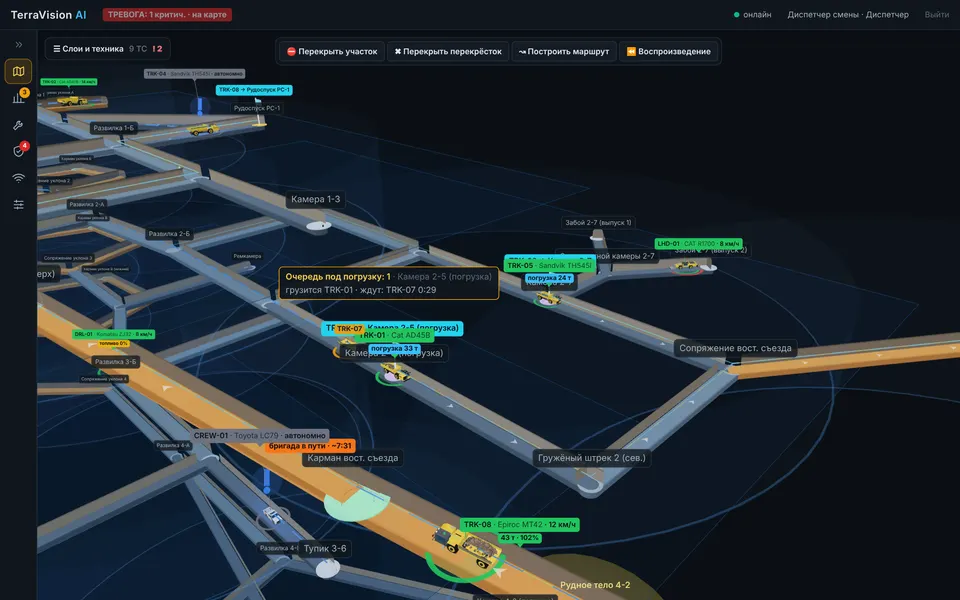
- Service integration: PTT, dispatch (TerraVision FMS), video, telemetry.
- Staff training and ongoing support.
Questions and answers
How does Private LTE differ from a corporate plan with a mobile operator?
On a corporate plan you share the operator's public network: the operator decides coverage and load, and traffic passes through its network. With Private LTE the base stations and core are dedicated to the company, traffic stays inside the perimeter and coverage is built where production needs it.
Does Private LTE work underground?
Yes. Underground coverage is provided with leaky feeder cable and small base stations along the workings. Public sources describe pilot networks at depths of 400 and 860 metres.
LTE or 5G?
LTE covers most tasks: voice, PTT, telemetry, video and dispatch. 5G is needed where minimal latency and high data volumes from machines matter, for example remote operation. An LTE network can be upgraded to 5G in stages.
Can the network work without the internet?
Yes. A private network runs as a closed loop: the core, base stations and application servers are on site, and no external connection is required.
Why is Private LTE better than Wi-Fi in an open pit?
One LTE base station covers kilometres while a Wi-Fi access point covers around a hundred metres, so a large, changing site needs far less LTE equipment. LTE also uses licensed spectrum and is designed for users moving between cells.
Sources
- Nokia, white paper "Private wireless communications for underground mines"
- Forbes Kazakhstan, 2025: Kcell presents Private LTE/5G technologies for industry
- ComNews, 2025: Private LTE/5G enterprise networks in Russia and Kazakhstan
- Industrial Safety Rules for hazardous facilities conducting mining and exploration (Order No. 352 of 30.12.2014)