

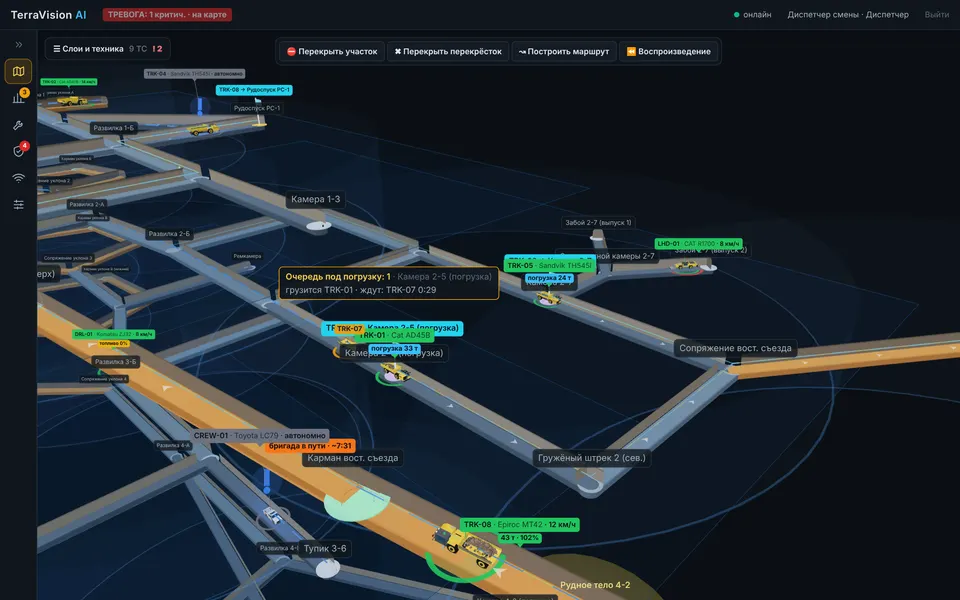
PTT over LTE (Push-to-Talk over Cellular, PoC) is press-to-talk group voice in which speech travels as data packets over an LTE / 5G or Wi-Fi network instead of a dedicated radio channel. The coverage area equals the network coverage: a mobile operator or the company's own Private LTE network. Besides voice, a PTT radio sends video, photos, text and location, and the dispatcher sees users on a map.
How it works
The user presses the PTT key and the whole group hears them. For the network this is a data exchange between the radio and a PTT server, so the distance between users does not matter: a crew in the pit, a dispatcher in the office and a manager in another city are in the same group.
3GPP standardises a professional version of this service, MCPTT (Mission Critical Push-to-Talk, from Release 13). It adds priority for emergency calls and latency targets: a call should be set up in about 300 ms. Devices labelled MCX support priority quality-of-service classes in the LTE network.
PTT over LTE vs DMR vs TETRA
| Parameter | PTT over LTE (PoC / MCPTT) | DMR | TETRA |
|---|---|---|---|
| Infrastructure | operator LTE / 5G, Private LTE or Wi-Fi | own repeaters | own base stations |
| Coverage | anywhere the network has coverage | within repeater range | within base station range |
| Data | voice, video, photos, location, apps | voice, short messages, location | voice, short messages, narrowband data |
| Groups | unlimited, changed from the dispatch console | channels and groups programmed into radios | groups within the network |
| Spectrum | no own frequencies needed on an operator network | frequency permit required | frequency permit required |
| Operation without a network | no, a network is required | yes, direct radio-to-radio mode | yes, direct mode (DMO) |
When PTT over LTE fits and when it does not
- Good fit: the site has stable LTE coverage or a Private LTE network; you need video, location and call recording; teams are spread across several sites.
- Not as the only system: where there is no cellular network and none is planned. Conventional radio with direct mode remains the choice there.
- Hybrid: the existing DMR network stays, and PTT over LTE adds data and reach beyond radio coverage. Whether groups can be bridged depends on the PTT platform.
What you need to launch
- A network: operator coverage, Wi-Fi or your own Private LTE on site.
- A PTT platform: a server or cloud service that manages groups and priorities.
- A dispatch console: map, groups, call recording.
- Terminals: PTT radios and smartphones with a dedicated PTT key, loud speaker and replaceable battery.
- Accessories: speaker microphones, headsets, multi-bay chargers, vehicle kits.
Which devices to choose
| Conditions | Devices | Examples from the catalogue |
|---|---|---|
| No hazardous areas: open pit, plant, warehouse, transport | RugGear rugged PTT radios and smartphones | RG190, RG380, RG440, RG725 |
| Hazardous Zones 1/21 and 2/22 | i.safe MOBILE explosion-protected radios and smartphones | IS440.1, IS380.1, IS540.1 |
| Mines with gas and dust hazards | M1 versions | IS440.M1, IS380.M1 |
| Vehicle or control room | mobile / dispatch radio | RG230 |
Questions and answers
Does a PTT radio over LTE work without a cellular network?
No. It needs a data network: operator LTE / 5G, a Private LTE network or Wi-Fi. Where there is no coverage, sites use conventional radios with direct mode or build a private network.
What is the range of a PTT radio over LTE?
Range is not limited by the distance between users. It works wherever the network has coverage, including between different cities and sites.
Do I need a frequency permit?
PTT on a mobile operator network needs no frequencies of your own. Conventional DMR and TETRA networks require a permit to use radio frequencies.
Can I install a PTT app on an ordinary smartphone?
Technically yes, but for shift work it is usually not enough: you need a dedicated PTT key, a loud speaker, glove operation, a replaceable battery and a protected housing. In hazardous areas only Ex-marked devices are allowed.
How does MCPTT differ from an ordinary PTT app?
MCPTT is a 3GPP standard for mission-critical services. It defines call priority and pre-emption, latency targets and the use of LTE quality-of-service classes. An ordinary PTT app sends voice as best-effort data with no guaranteed priority.
Sources
- 3GPP TS 22.179, Mission Critical Push To Talk (MCPTT), Release 13 onwards
- ETSI TS 102 361 (DMR) and ETSI EN 300 392 (TETRA)
- Device specifications: RugGear and i.safe MOBILE manufacturer data