

M2 Solutions is a system integrator based in Almaty. For mining companies in Kazakhstan we build Private LTE / 5G networks in open pits and underground workings, supply RugGear PTT radios and rugged smartphones and i.safe MOBILE explosion-protected devices in the M1 mining version, and deploy our own TerraVision FMS dispatch system.
Mine tasks and how we solve them
| Task | Solution | In the catalogue |
|---|---|---|
| Pit communications: dispatcher, drivers, shovel operators, crews | a Private LTE network and PTT radios with a dedicated key | Private LTE / 5G, RugGear radios |
| Voice and data in underground workings | LTE coverage over leaky feeder cable and small base stations | Leaky feeder cable, base stations |
| Personnel positioning, alerting and search | BLE / UWB tags and anchors, SOS and man-down signals, dispatcher alarms | TerraVision FMS |
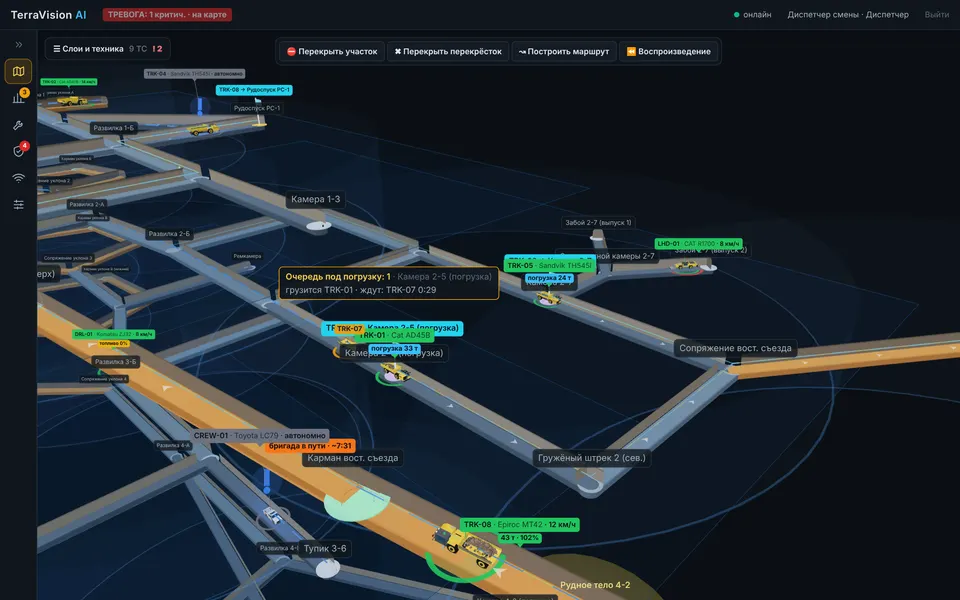
| Fleet dispatch and shift production tracking | 3D mine map, tasks, trips, downtime, machine health | TerraVision FMS |
| Devices for mines with gas and dust hazards | M1 smartphones, radios and tablets (I M1 Ex ia I Ma) | IS540.M1, IS440.M1, IS940.M1 |
| Site video surveillance | IP and thermal cameras over the private network | AXIS cameras |
| Equipment monitoring without cabling | wireless vibration, pressure and temperature sensors | SENSAiO sensors |
What the safety rules require
Kazakhstan applies the Industrial Safety Rules for hazardous facilities conducting mining and exploration (Order No. 352 of 30.12.2014). For underground mining they require sites to have monitoring, emergency alerting, positioning and personnel search systems, plus a direct telephone line and a backup alternative link to the emergency rescue service.
The system must deliver the dispatcher's message individually to every worker in the mine and locate people and machines. That is why underground communications are designed not as a stand-alone service but as the base for positioning, alerting and dispatch.
Why a private LTE network
An open pit changes every week: benches advance, haul roads and loading points move. Wi-Fi has to be relocated constantly, while one LTE base station covers kilometres and is designed for machines moving between cells. See the detailed comparison in the guide Private LTE / 5G for industry.
According to Forbes Kazakhstan (2025), Private LTE / 5G networks are already deployed at 10 or more mining sites in the country.
How we work
- Survey the site: terrain, workings, existing communications, needs of each service.
- Calculate coverage and design the network.
- Supply equipment and terminals, install and configure.
- Connect services: PTT, dispatch, positioning, video.
- Train staff and support the system.
Questions and answers
How do you organise communications in an open pit?
Usually one of two options or a combination: conventional DMR radio for voice, and a Private LTE network that carries dispatch data, video and machine telemetry in addition to voice and PTT. The choice depends on site size and whether data is needed besides voice.
What communications work underground in a mine?
Underground, radio propagates only along the workings, so coverage is built with leaky feeder cable, Wi-Fi access points or small LTE base stations. A private LTE network provides voice, PTT, data and the base for personnel positioning on one infrastructure.
Does a mine need explosion-protected phones?
It depends on the site category. Mines with gas or dust hazards use Group I mining equipment such as M1. Open pits and mines without an explosive atmosphere can use rugged devices without Ex protection. The requirement is set by the project and the safety rules for the specific site.
How does a PTT radio over LTE differ from a conventional radio in a pit?
A PTT radio uses the cellular network, so it works wherever there is coverage and sends location, photos and video as well as voice. A conventional DMR radio works within range of its repeaters but does not depend on a cellular network.
Can you see people and machines underground in real time?
Yes. The TerraVision FMS dispatch system shows machines and people on a 3D mine map using BLE tags, UWB anchors and private LTE nodes, and receives SOS and man-down signals.
Sources
- Industrial Safety Rules for hazardous facilities conducting mining and exploration (Order No. 352 of 30.12.2014)
- Forbes Kazakhstan, 2025: Kcell presents Private LTE/5G technologies for industry
- Device specifications: i.safe MOBILE, RugGear and SENSAiO manufacturer data